
The Rise of AI Agents in 2026: How Intelligent Automation Is Replacing Traditional Software
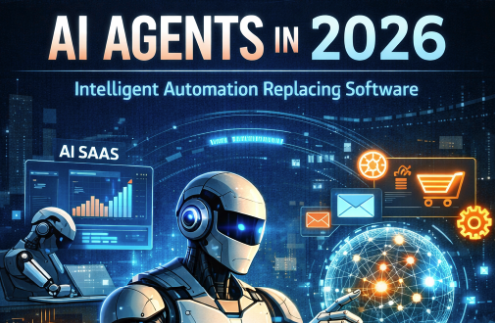
From startups to enterprises, companies are integrating AI agents into workflows to reduce operational costs, increase speed, and unlock new levels of productivity. This is not incremental improvement. It is a structural change in how software works.
What Are AI Agents?
AI agents are autonomous systems powered by large language models (LLMs) that can:
- Understand goals
- Break them into subtasks
- Execute actions using tools or APIs
- Adapt based on feedback
Unlike traditional automation scripts, AI agents are dynamic. They do not just follow rules — they reason.
For example, instead of manually generating reports, sending emails, updating CRM entries, and tracking invoices, an AI agent can handle the entire workflow from start to finish.
Why AI Agents Are Replacing Traditional SaaS Workflows
Traditional SaaS products rely on structured user input. You click buttons, fill forms, and trigger predefined actions.
AI agents flip this model.
Instead of navigating software, users describe outcomes:
“Generate this month’s revenue report, identify churn risks, and email a summary to the sales team.”
The agent handles the rest.
This shift reduces friction and eliminates repetitive interface interactions. It turns software from a tool into a collaborator.
Key Technologies Powering the AI Agent Revolution
- Large Language Models (LLMs)
Advanced models enable reasoning, summarization, and contextual understanding. - Tool Calling & API Integration
Agents can connect to payment gateways, CRMs, analytics tools, and databases. - Memory Systems
Persistent memory allows agents to learn from previous interactions. - Multi-Agent Architectures
Specialized agents collaborate — one for research, one for execution, one for validation.
Real-World Applications in 2026
AI agents are already transforming multiple industries:
- Finance: Automated bookkeeping, fraud detection, invoice processing
- E-commerce: Dynamic pricing, personalized marketing campaigns
- Customer Support: Intelligent ticket resolution and sentiment analysis
- Software Development: AI-powered debugging, documentation, and testing
Startups are building agent-first products rather than adding AI as a feature.
Benefits of AI-Driven Automation
- Reduced operational costs
- Faster execution cycles
- Scalable decision-making
- 24/7 productivity
- Improved data utilization
For technical founders and SaaS builders, AI agents offer a competitive advantage that compounds over time.
Challenges to Consider
Despite the promise, AI agents are not flawless.
- Hallucination risks
- Security concerns with API access
- Data privacy regulations
- Infrastructure costs
Responsible implementation requires guardrails, monitoring systems, and clear governance policies.
The Future: Agent-First Software
The next generation of SaaS will not be dashboard-heavy platforms. It will be intent-driven systems where users communicate goals instead of navigating interfaces.
Companies that adopt agent-first thinking today will build more adaptive, scalable, and intelligent products tomorrow.
The question is no longer whether AI will transform software.
The question is whether your product will evolve fast enough to stay relevant.
Comments
Read Next
10 Software Development Trends That Will Define 2026
AI writes 46% of code. Low-code hits $44.5 billion. Edge computing crosses $257 billion. Here are the trends reshaping how software gets built and what they mean for your next project.


How to Vet Flutter Developers Like a Pro: 15-Point Checklist + Interview Questions That Actually Work
Flutter transforms the entire app development process. Build, test, and deploy beautiful mobile, web, desktop, and embedded apps from a single codebase.